Brighton Facts

Home Warren's Blog Warren's Tours Mt. Hope Cemetery Mt. Hope Notables Rochester Trivia Interesting Facts Brighton Pioneers Brighton Facts Brighton Cemetery Brighton History History Research History Question Mansions Tour Warren's Book Warren's Lectures

bulletWhere is the "Lost City of Tryon?"
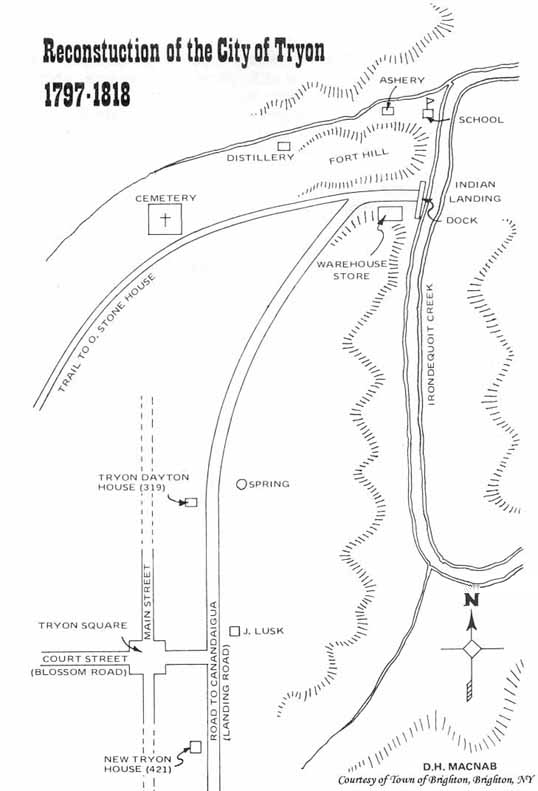
bulletJohn Tryon bought 200 acres of high ground near the Indian Landing at Irondequoit Creek in 1797. The Landing was a very important fur trading location with early settlers and Indians. Tryon started an ashery, distillery and the first store in 1799, where one could buy or trade furs, liquor, flour, potash, and salt. A grist mill was also added in 1804 providing flour, a major trade commodity with Canada. Tryon unfortunately did not develop into the booming trade center it hoped to be. Rochesterville developed as the prosperous milling town on the Genesee River, Charlotte was officially made a port city in 1804 and Tryon was abandoned in 1818. Click on this link to a map reconstructing the "Lost City of Tryon.

bulletHow did Brighton get its name?
bulletWilliam Billinghurst  lived in Brighton, England. When he came to the area he named it Brighton. He lived on Monroe Avenue north of Westfall Road and is buried in the Brighton Cemetery.

bulletWhat is the Council Rock and why is it important?
bulletThis is a famous landmark near the Stone Tavern where the Iroquois Nation held many tribal councils. The rock was located at the juncture of an old Indian trail from Canandiagua to the Genesee Falls and another trail from the Indian Landing at Irondequoit Creek. There was also a mighty elm tree at the Council Rock so this "rock and elm" were often used as a point of reference for all early travelers. On some tribal council occasions, Orringh Stone collected the Indians' rifles, if they were under the influence of "firewater," to avoid any incidents. Click on the link to learn more about early pioneer Orringh Stone.

bulletHow did Allen's Creek get its name?
bulletTimothy Allyn of Connecticut bought 500 acres along a stream and built a log cabin at the corner of East Avenue & Allyn Creek Road. He did not like this wilderness and moved to  the booming metropolis of Geneva after one summer. The road and the stream were named after him and the original spelling of "Allyn" was simplified to "Allen" years later.

bulletWhat was potash, a highly sought commodity of the early settlers, used for?
bulletPotash was made by burning wood, which was of course plentiful around here due to the very dense woods in Genesee Country. It was commercially made in facilities called asheries which were erected around many of the early settlements, including Tryon.  Potash was used as a fertilizer, but more importantly as a component to manufacture gunpowder.

bulletWhere was the Christmas light district in Brighton?
bulletIn the early 1900's Browncroft was the Christmas light district attracting over 10,000 passersby to see the beautiful Christmas light displays.

bulletWhat was the Merchant's Road?
bulletThe merchants of Canandaigua wanted a way to sell their goods to much larger markets in the west and also north to Canada. In 1804 they cleared a path which became know as the "Merchants Road." This road from Canandaigua went to Tryon and also down present day Browncroft and Merchants roads, northwest though Irondequoit by the Hooker cemetery, off Portland Ave, towards the Port of Charlotte.

bulletHow could 40 ton schooners be built and launched in Irondequoit Creek at the Indian Landing?
bulletIrondequoit Creek was called a river in the early days and was a quarter mile wide in some places. It was so deep and wide that lake sailing vessels could come off Lake Ontario, sail  Irondequoit Bay and actually into Irondequoit Creek. 

bulletWho is Cobb's Hill named after?
bulletIt is named after Gideon Cobb, an early peddler of axes & scythes. Click on this link to find out more about early pioneer Gideon Cobb.

bulletWhat road was originally called Hillside Avenue when it was cleared in 1812?
bulletA section of French Rd. from East Avenue to Clover Street was originally called Hillside Avenue.

bulletDid the Underground Railroad operate in Brighton?
bulletYes, it did. The Warrant home on West Henrietta Road was a well know stop on the Underground Railroad. 

 
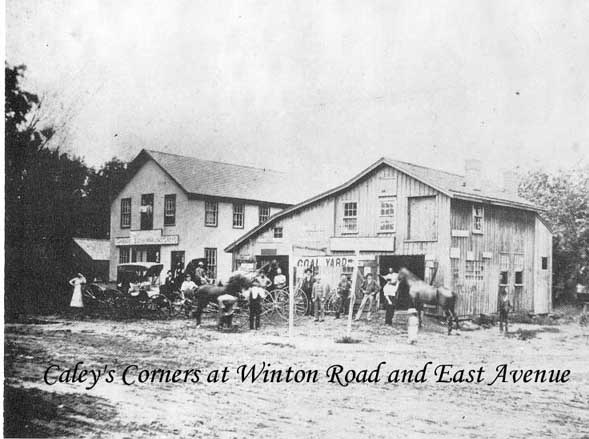
bulletWhere was Caley's Corners located?
bulletThe Caley family and their descendants lived at the northwest corner of East Avenue and Winton Road at the heart of the old village of Brighton. They occupied the original family homestead near the Erie Canal for one hundred and three years, had a wagon repair business, and sold coal. Take a look at Caley's Corner below. 

caleyscorners1.jpg (42058 bytes)

bulletWhat was on the land now occupied by Briar Manor Apartments at French Road and Edgewood Avenue?
bulletThe Rochester Gun Club who had many acres of shooting ranges.

bulletWhich Brighton family had a dairy farm originally know as the Greyknolls Dairy?
bulletThe Crittenden family had a dairy farm with many Guernsey cows. To learn more about this pioneer family click  on this link .

bulletWhat is the name of the first Monroe County park?
bulletThe first park in the County was Ellison Park opened in 1927. The first park in the city of Rochester was Highland Park which dates back to 1888.

bulletWhere did the Town of Brighton carry on its business from its founding until 1928?
bulletOfficial Brighton business was conducted in the home of the Town Clerk, until it rented part of a building at 1795 Monroe Avenue in 1928. In 1953 official business was conducted in the new Town Hall on Elmwood Avenue .

bulletWhere was the first land for flying airplanes in the area?
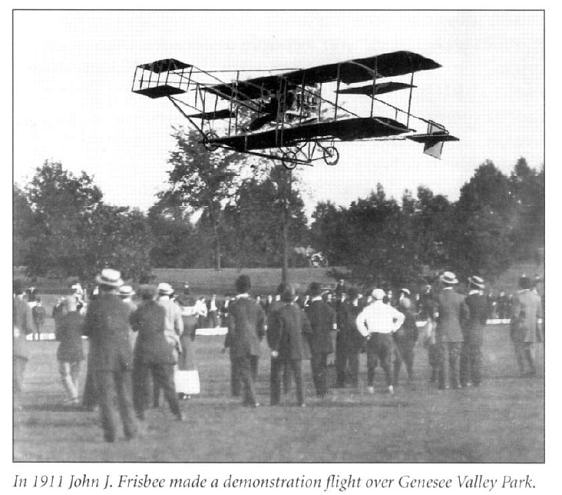
bulletThe first airfield was located where the present Brighton Town Hall is. John J. Frisbie a noted balloonist, was the first pilot to make what was considered a "long" flight. He flew over Genesee Valley Park to demonstrate to Rochesterians that planes could do more than short hops it the air in his Curtiss plane, powered by an engine
made by Rochester's Elbridge Engine Company,
from this location on July 7, 1911. Frisbee set off on July 7, 1911 from Cobb's Hill flying northward toward the New York Central Railroad Depot following their tracks and back at a maximum altitude of 300 feet. He nearly crashed when his plane engine sputtered and the vibrations were so strong that he feared the plane could come apart; but he made the round trip flight, less than 300 feet in the air.

frisbeejohn.jpg (48054 bytes)

Home Warren's Blog Warren's Tours Mt. Hope Cemetery Mt. Hope Notables Rochester Trivia Interesting Facts Brighton Pioneers Brighton Facts Brighton Cemetery Brighton History History Research History Question Mansions Tour Warren's Book Warren's Lectures